

Last Updated: November 2, 2026
Quick Summary
The best cat toys for active indoor cats trigger the full hunting sequence of stalking, chasing, pouncing, and kicking, and they do not need to be expensive. Choose toys that move unpredictably and match your cat's hunting style, then rotate them every one to two weeks to keep playtime novel.
- Wand toys work best when you drag them along the floor and behind furniture, not overhead.
- Kicker toys let cats grab, hug, and rake with their back legs, covering the wrestling stage.
- Rotate toys in three groups and swap every one to two weeks, or sooner if interest fades.
- Automatic toys should supplement interactive play, not replace you, and need an auto-off switch.
- Retire any toy with a torn seam, loose bell, or frayed string immediately.
Table of Contents
- What Active Indoor Cats Actually Need From a Toy
- Interactive Cat Toys for Bored Cats: Wands, Kickers, and Puzzles
- Automatic Cat Toys for When You Are Away
- How to Rotate Cat Toys So Playtime Stays Novel
- Frequently Asked Questions
What Active Indoor Cats Actually Need From a Toy
An active indoor cat needs a toy that triggers the full hunting sequence: stalking, chasing, pouncing, and kicking. Without that outlet, indoor cats redirect their prey drive into furniture, ankles, and 3 a.m. sprints down the hallway.
Best Friends Animal Society's enrichment guidance notes that toys encouraging chasing and pouncing are typically the most enjoyable for cats, and that simple household items like cardboard boxes and large paper bags can work as well as anything you buy. The best cat toys for active indoor cats are not the most expensive ones.
A 2026 review of the year's cat toys scored a Rainbow Cat Charmer at 10/10, a carrot catnip toy at 9/10, and a stuffed fish at just 7/10 (Catastrophic Creations toy review). The toys that let a cat hunt scored highest; static plush scored lowest.
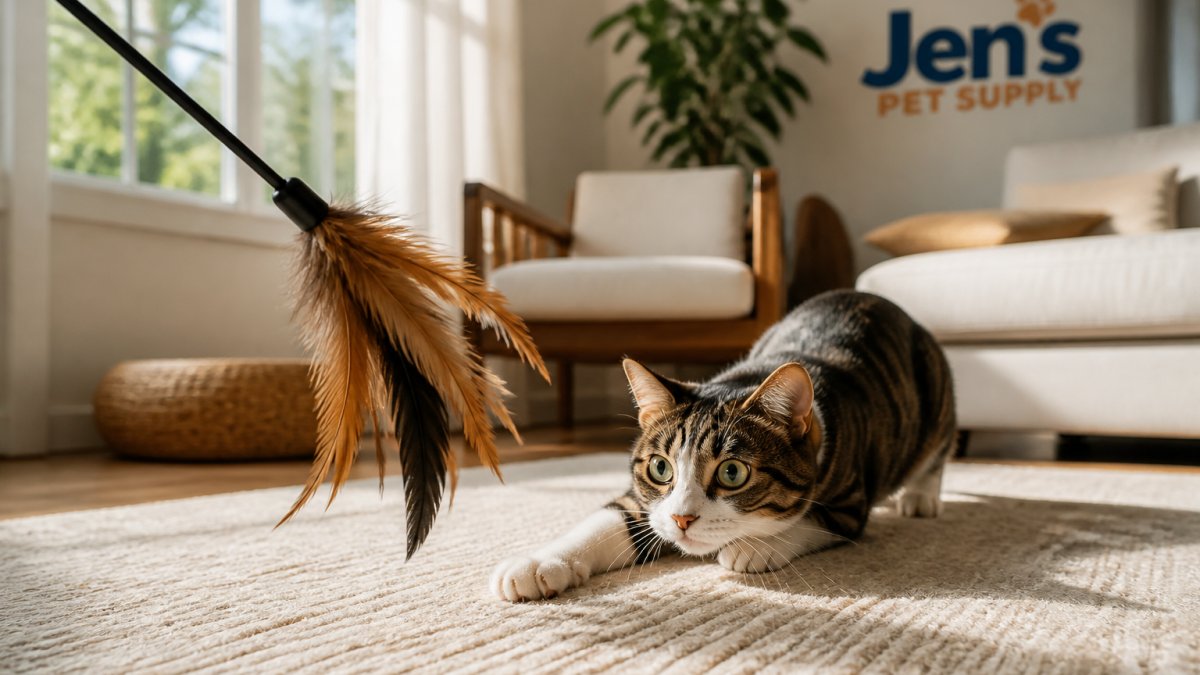
"Active" is not one personality. Some cats are chasers who need speed, others are stalkers who need cover and patience, and others are wrestlers who want something to grab and bunny-kick. A toy that ignores your cat's hunting style will sit in the bin no matter how many five-star reviews it has.
For cats with serious running energy, a carpeted exercise wheel gives them a place to burn it off indoors. Our 41-inch natural wood cat exercise wheel has a silent roller and a built-in lock, so you can control playtime.

Watch out: Toys with small pieces or linear, strand-like parts can detach when chewed and be swallowed, so feather toys are best used under supervision rather than left alone with a cat who eats them.
Interactive Cat Toys for Bored Cats: Wands, Kickers, and Puzzles
Interactive play is one of the most effective ways to engage a bored cat, and wand toys do much of the work. A wand mimics a fleeing bird or bug, so your cat gets to stalk, chase, and catch in sequence.
The key is how you move it. Drag the wand along the floor and behind furniture rather than dangling it overhead. Cats want to stalk something that acts like prey, and prey runs away and hides.
Our feather wand with a bell and crinkle ball is built for that kind of session, with a non-slip grip and a rustling ball that keeps cats locked on. If you want hands-free play while you work, the suction cup teaser wand sticks to a hard surface and lets your cat bat at it independently.
Kicker toys cover a different part of the hunt. The elongated shape lets a cat grab, hug, and rake with its back legs, which is the wrestling stage of the sequence. Our three-piece catnip cucumber kicker set pairs the same shape with catnip and a crinkle sound, and the plush holds up to daily biting and carrying.

Then there are puzzle feeders and enrichment boards, which work the brain rather than the legs. PetMD's guide to cat toys lists puzzle feeders, foraging mats, and motion-activated toys among the options worth rotating in. A felt maze with a bell ball gives a cat a problem to solve and a reward for solving it, and it needs no batteries.
| Toy type | What it triggers | Best for | Play style |
|---|---|---|---|
| Wand and feather | Stalking, chasing, pouncing | Most active cats | You move it, cat hunts |
| Kicker | Wrestling, bunny-kicking | Cats who grab and bite | Solo or paired with catnip |
| Puzzle and maze | Foraging, problem-solving | Smart, food-motivated cats | Independent |
| Motion-activated ball | Chasing, swatting | Cats who need movement | Independent |
Automatic Cat Toys for When You Are Away
Automatic toys keep a cat moving during the hours nobody is home, but they work best as a supplement, not a replacement for you. A motion-activated toy gives a cat something to chase at 2 p.m. on a Tuesday. It does not give the cat a hunting partner.
Interactive Cat Toys For Indoor Cats Automatic Kitten Toys Moving Feather →
Self-rolling balls are the simplest version. They spin, shake, and reverse when they hit a wall, which keeps the movement unpredictable enough to hold attention. Our rechargeable interactive rolling ball runs on three modes, charges in about 20 minutes, and runs for up to six hours of play.

For cats who like to watch as much as chase, a wall-hanging bird toy with a chirping sound and built-in catnip adds sensory engagement without batteries. It suits the cat who spends the afternoon on a windowsill anyway.
The 2026 testing project that evaluated 65 cat toys was built around exactly this problem: keeping indoor cats active when owners cannot be there (2026 cat toy testing project). Automatic toys earn their place when they move unpredictably and shut off on their own.
Watch out: A toy that runs all night will keep your cat, and you, awake. Look for an automatic off switch or a sleep timer, and pick up anything with a cord before you leave the house.
How to Rotate Cat Toys So Playtime Stays Novel
Rotation is the cheapest enrichment upgrade there is, and it takes about five minutes a week. Cats habituate to toys fast. A toy that sat in the open for a month is new again after two weeks in a drawer.
Here is the rotation routine we recommend:
- Sort toys into three groups: active play (wands), solo play (balls, kickers), and brain games (puzzles)
- Keep one group out at a time, and store the other two out of sight
- Swap groups every one to two weeks, or sooner if your cat loses interest
- Retire any toy with a torn seam, loose bell, or frayed string immediately
- Pair the swap with a five-minute wand session so the new toys arrive with excitement
The rotation works because novelty, not the toy itself, drives a cat's interest. A bored cat does not need more toys, it needs the same toys presented differently.
Age changes the rotation, too. Kittens do well with lighter wands and soft kickers they can carry. Senior cats often prefer toys that move slowly and stay on the floor, plus puzzle feeders that reward a short, low-effort hunt. A cat with arthritis will not chase a fast wand, but it will bat at a ball that rolls a few inches away.
Noise is the other factor most guides skip. Bells and crinkle material are great for alert cats and miserable for a household with a light sleeper. If your cat plays at night, choose quiet toys for the overnight rotation and save the noisy ones for daytime.
Building a play routine that holds up takes a few good toys and a little structure, not a closet full of things your cat ignores. At Jen's Pet Supply, we stock wands, kickers, puzzle toys, and automatic toys for cats at every energy level, and we would rather help you pick three that fit your cat than sell you ten that do not. Start with one interactive toy, one solo toy, and one puzzle, then rotate from there. Shop Jen's Pet Supply and give your indoor cat a hunt worth chasing.
Frequently Asked Questions
What are the most stimulating toys for indoor cats?
Toys that trigger the full hunting sequence work best: stalking, chasing, pouncing, and kicking. A feather wand lets you mimic prey movement and gives your cat a target to stalk. Kicker toys with catnip satisfy the wrestling and bunny-kicking stage. Puzzle toys add problem-solving after the chase ends. Rotating between these types keeps the mental stimulation from fading, which matters more than any single toy.
Are automatic cat toys safe for unsupervised play?
They can be, with the right pick. Choose battery or USB-powered toys with no loose string, ribbon, or detachable small parts, since linear strands and small pieces can separate and be swallowed. The automatic feather toy at Jen's Pet Supply runs five minutes every four hours and shuts off in the dark. Check the toy for wear before each session.
How do I choose the right toy for a high-energy cat?
Watch one play session and note what your cat does first. A cat that stalks and pounces needs a wand toy. One that grabs and kicks wants a catnip kicker. A cat that bats at things under furniture does well with a rolling ball or puzzle box. Matching the toy to the behavior your cat already shows beats buying whatever looks busiest.
