

Last Updated: October 31, 2026
Quick Summary
Essential puppy supplies for beginners come down to a short list of basics: food and bowls, a crate and bedding, a collar and leash, training treats, grooming tools, and cleanup gear. Buy in tiers so you're not replacing everything in a month, starting with feeding and safe confinement before adding walking, training, and grooming items.
- Must-haves keep your puppy fed, safe, and house-trained; nice-to-haves only add convenience.
- Tier 1 and Tier 2 supplies cover your puppy's first week at home.
- A crate speeds house-training and should let your puppy stand, turn, and lie down.
- Recheck collar and harness fit every two to three weeks as your puppy grows.
- Skip retractable leashes, prong collars, and choke collars for beginner training.
Table of Contents
- The New Puppy Checklist: What You Actually Need Before Day One
- Feeding Supplies: Bowls, Food, and Safe Storage
- Puppy Crate and Bedding: Building a Safe Space
- Walking Gear: Collars, Leashes, and Harnesses That Fit
- Puppy Training Supplies for the First Weeks
- Puppy Grooming Supplies for a Healthy Coat and Clean Paws
- Puppy-Proofing Your Home and Choosing Safe Products
- What to Skip or Delay When Buying Puppy Supplies
- Setting Up Your First Week With a New Puppy
- Shop Jen's Pet Supply for Your Puppy Essentials
- Frequently Asked Questions
The New Puppy Checklist: What You Actually Need Before Day One
Bringing home a puppy is exciting, and also a little overwhelming when you're staring at a wall of products wondering what's truly necessary. Essential puppy supplies for beginners come down to a short list of basics: food and bowls, a crate and bedding, a collar and leash, training treats, grooming tools, and cleanup gear. Everything else can wait.
New owners often overspend on gadgets they never touch while skipping the one item that actually solves a problem. Below, we'll show you exactly how to prioritize, what to buy first, and what to leave on the shelf.
The stakes are real. The American Veterinary Medical Association notes that a puppy's first weeks shape lifelong behavior and health habits, so the gear you choose should support training and safety, not just look cute in photos.
Puppy supplies fall into two categories: the items that keep your puppy fed, safe, and clean, and the extras that make life easier once the basics are handled.
The Must-Haves vs. the Nice-to-Haves
Must-haves keep your puppy alive, safe, and house-trained. Nice-to-haves improve convenience.
- Must-have: food, bowls, crate, bedding, collar with ID tag, leash, training treats, waste bags, grooming basics, pet-safe cleaner
- Nice-to-have: elevated feeding stand, extra toys, clothing, travel carriers, puzzle feeders
A common mistake new owners make is buying the nice-to-haves first. Start with the must-haves and add the rest as your puppy grows.
A Budget-Friendly Starter Kit by Priority
Buy in tiers so you're not replacing everything in a month.
| Priority | Items | Why It Comes First |
|---|---|---|
| Tier 1 | Food, bowls, crate, bedding | Feeding and safe confinement |
| Tier 2 | Collar, leash, ID tag, waste bags | Safe walks and identification |
| Tier 3 | Training treats, chew toys | Behavior and teething relief |
| Tier 4 | Grooming tools, pet-safe cleaner | Hygiene and accident cleanup |
Tier 1 and 2 cover the first week. Tiers 3 and 4 fill in as routines settle.
Feeding Supplies: Bowls, Food, and Safe Storage
Feeding supplies are the foundation of your puppy's daily routine, and the right setup prevents messy meals and spoiled food. You need two bowls, an age-appropriate puppy food, and an airtight storage container.
Stainless steel or ceramic bowls are easiest to sanitize. A ceramic bowl set works well for small and medium puppies because the weight keeps it from sliding across the floor during enthusiastic eating.
Puppy food should match your dog's growth stage. The Pet Nutrition Alliance recommends choosing a food that meets established nutritional profiles and feeding amounts based on your puppy's expected adult weight, not the bag's largest suggested portion.
Store dry food in an airtight bin kept in a cool, dry place. Keep the original bag inside the bin so you retain the lot number and expiration date, which matters if a recall is ever issued.
Watch out: free-feeding a puppy makes house-training and weight management much harder. Scheduled meals give you predictable potty times.
Puppy Crate and Bedding: Building a Safe Space
A crate is the single most useful purchase for a new puppy. It speeds house-training, prevents destructive chewing when you can't supervise, and gives your puppy a quiet retreat. Pair it with washable bedding and the crate becomes a genuine safe space.
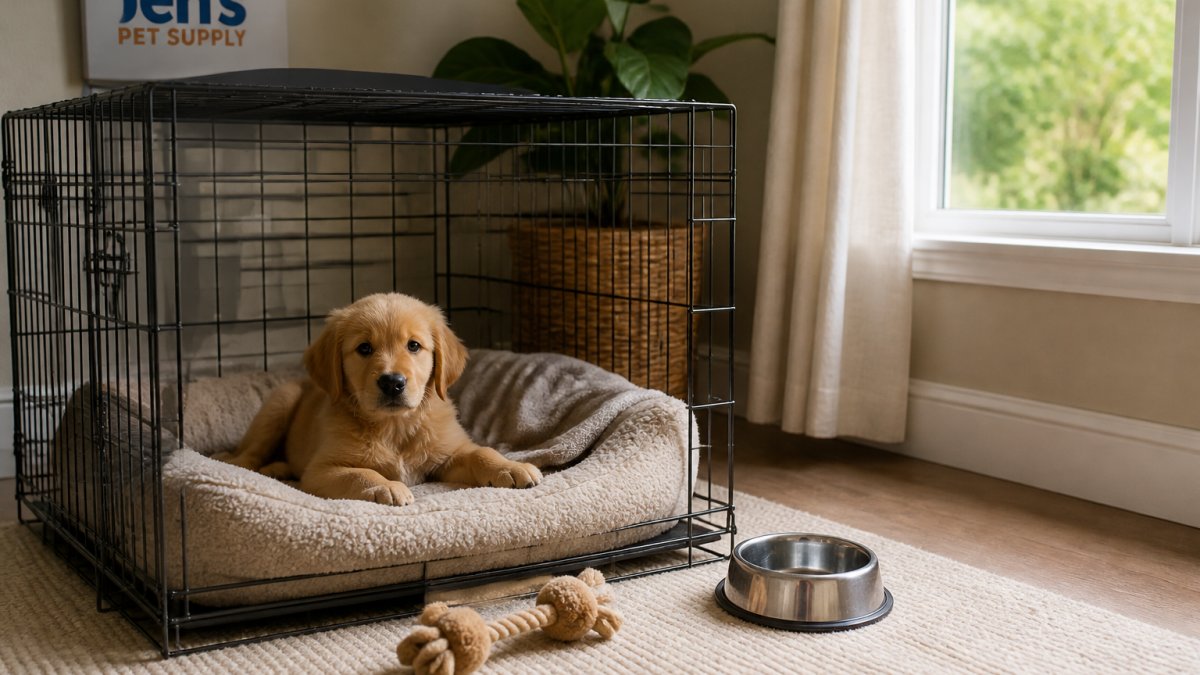
Size matters more than style. Your puppy should be able to stand, turn around, and lie down comfortably, but the crate shouldn't be so large that one corner becomes a bathroom. Many crates include divider panels so you can shrink the space as your puppy grows.
Bedding should be machine washable, because accidents happen. Avoid loose blankets that can bunch up, and skip anything with small parts a teething puppy could chew off and swallow.
Crate vs. Playpen: Do You Need Both?
A crate is for sleeping and short confinement; a playpen is for supervised awake time in a larger safe zone. Beginners can start with a crate alone. If you have an open floor plan or a puppy who needs room to move while you work, a playpen earns its place.
An 8-panel portable pet pen sets up without tools and works indoors or in the yard, which helps when you want to keep a puppy contained near you rather than locked in another room. That proximity matters: puppies settle faster when they can see you.
Walking Gear: Collars, Leashes, and Harnesses That Fit
Walking gear has to fit a moving target. A puppy can gain a significant share of its adult weight within a few months, so the collar, harness, and leash you buy on day one are temporary by design. The goal is not to buy gear that lasts forever; it is to buy gear that stays safe and comfortable until your puppy outgrows it, then replace it once.
Sizing for a puppy that will grow
Start by estimating adult size. Your veterinarian can give you a rough adult-weight range at your puppy's first visit, and breed or mix characteristics help fill in the rest. Use that estimate to pick adjustable gear rather than fixed-size gear.
- Collar: Choose a flat nylon or leather collar with several inches of adjustment range. A buckle collar with a metal D-ring is the baseline. Measure your puppy's neck circumference with a soft tape and add roughly two fingers of slack, then recheck every two to three weeks. Puppies grow fastest between roughly four and eight months, so a collar that fits in week one can be tight by week six.
- Harness: A harness should be adjustable at the chest and neck. Measure the widest part of the ribcage behind the front legs and follow the manufacturer's sizing chart rather than guessing by breed. A harness that is too loose lets a puppy back out; one that is too tight rubs the armpits. Check for redness or chafing after every walk.
- Leash: A standard six-foot flat leash in nylon or leather is the right training tool. Width matters: a thin leash is fine for a small puppy, but a strong, large-breed puppy benefits from a wider leash with a sturdy metal clip.
A nylon collar and leash set gives beginners a complete, ready-to-use pairing for those first short walks, and the adjustable collar buys time before you need to size up. Add a harness if your puppy pulls or has a delicate neck, and always attach the leash to the harness D-ring rather than the collar for walks.
ID tags and microchips
A collar is only useful for identification if it carries information. A flat ID tag with your phone number is the minimum, and a second tag with a backup number or address helps. Microchips are permanent identification implanted by a veterinarian; they do not replace a visible tag, but they give a lost puppy a second chance. Keep your microchip registration current if you move or change phone numbers.
What to avoid in walking gear
- Retractable leashes: They teach constant pulling and offer poor control near traffic. A standard six-foot leash is the better training tool.
- Prong or choke collars: These rely on discomfort and are not appropriate for beginner training. Reward-based training with a flat collar or harness works faster and is safer for a growing puppy's neck.
- Oversized gear: A collar or harness bought for adult size will slip off a puppy. Buy adjustable gear sized to the puppy now, and plan to replace it.
Don't forget waste bags. A waste bag holder clips to the leash so you're never caught without one. In practice, the owners who train reliably are the ones who never have an excuse to skip a pickup.
When to replace walking gear
Replace a collar or harness when the adjustment range runs out, when stitching frays, or when the buckle or clip shows wear. A puppy that has doubled in weight will likely need a new harness before it needs a new leash. Keep the old gear as a backup only if it still fits safely; otherwise retire it.
Puppy Training Supplies for the First Weeks
Training supplies are simple: high-value treats, a treat pouch, a clicker if you choose clicker training, and a chew toy that redirects teething. Reward-based training works fastest when treats are small, smelly, and easy to deliver.
A training treat pouch keeps rewards within reach so you can mark good behavior the instant it happens. Timing is everything in puppy training; fumbling in a pocket for a treat teaches your puppy nothing.
For teething, a Puppy KONG treat-stuffing chew toy is designed for puppies between two and nine months, with a softer rubber formula built for puppy teeth and gums. Stuff it with treats or peanut butter to keep a puppy busy during crate time. Never leave a puppy unattended with any toy.
Puppy KONG Treat-Stuffing Chew Dog Toy →
The American Kennel Club recommends short, frequent training sessions for puppies, which is why a treat pouch and a handful of tiny rewards matter more than any expensive gadget.
Puppy Grooming Supplies for a Healthy Coat and Clean Paws
Grooming supplies keep your puppy comfortable and catch health issues early. At minimum, you need a brush suited to your puppy's coat, nail clippers, puppy-safe shampoo, and a comb for tangles.
A detangling comb helps prevent mats in longer-coated breeds and works gently through puppy fur during early handling sessions. Getting a puppy used to brushing now makes adult grooming far easier.
Breed matters here. Double-coated breeds need regular brushing and should never be shaved. Short-coated breeds need less brushing but still need nail trims and ear checks. Ask your veterinarian or groomer how often your specific breed needs professional grooming.
Watch out: human shampoo disrupts a puppy's skin barrier. Use a formula labeled for dogs, and rinse thoroughly.
Puppy-Proofing Your Home and Choosing Safe Products
Puppy-proofing is the process of removing or securing hazards before your puppy explores them, and it prevents the most common emergencies new owners face. Walk each room at your puppy's eye level and ask what could be chewed, swallowed, or pulled over. Then apply the same scrutiny to the products you buy, because a toy or crate that is unsafe is worse than no product at all.
Room-by-room hazard checklist
- Secure electrical cords and cover outlets
- Move cleaning products and medications to locked cabinets
- Block stairs with a gate
- Remove toxic plants and small swallowable objects
- Secure trash cans with lids
- Store shoes, socks, and kids' toys out of reach
- Tuck blind and curtain cords out of reach
- Check for gaps behind furniture and under beds where a puppy could wedge itself
Choose pet-safe cleaners for accidents. Enzymatic cleaners break down odor molecules so your puppy doesn't return to the same spot, which is the real reason house-training stalls.
Toy size and chew durability
A toy that is too small can be swallowed; a toy that is too soft can be shredded and ingested. Match toy size to your puppy's mouth, not to its breed label.
- Size rule: A toy should be large enough that your puppy cannot fit it entirely into its mouth. When in doubt, size up.
- Durability rule: Puppy teeth are sharp but not strong. Soft rubber and fabric toys are appropriate for teething, but inspect them daily for tears and discard anything with exposed stuffing or squeaker parts.
- Supervision rule: Never leave a puppy unattended with any toy. Chew toys are for supervised or crated downtime, not free access all day.
A Puppy KONG treat-stuffing chew toy is designed for puppies between two and nine months, with a softer rubber formula built for puppy teeth and gums. Stuff it with treats or peanut butter to keep a puppy busy during crate time, and check it for cracks after each use.
Crate safety checks
A crate is only safe if it is set up correctly. Before your puppy goes in, confirm:
- The crate is stable and cannot tip if a puppy jumps against the side.
- There are no loose wires, protruding screws, or sharp edges inside.
- The door latch is secure and cannot be nosed open.
- Bedding has no small parts, buttons, or loose threads that can be chewed off.
- The crate is not placed near a heat source, a draft, or a cord.
Household products that pose hidden risks
Some everyday items are more dangerous than they look. Keep these out of reach:
- Human medications: Even small doses of common pain relievers can be toxic to dogs. Store all medications in closed cabinets.
- Sugar-free foods: Products sweetened with xylitol are highly toxic to dogs. Check gum, candy, peanut butter, and baked goods labels.
- Cleaning concentrates: Dilute and store according to the label, and keep puppies out of treated areas until dry.
- Fertilizers and pest control: Follow label instructions and keep puppies off treated lawns for the recommended interval.
First-aid and emergency planning
A first-aid kit for a puppy can include gauze, adhesive bandages, tweezers, antiseptic wipes, and a tick-removal tool. The AVMA's pet first-aid guidance recommends keeping your veterinarian's number and an emergency clinic's address posted where you can find them fast.
Go a step further than the kit: save your veterinarian's number and the nearest emergency clinic's address in your phone, keep vaccination and parasite-prevention records in one folder, and know the signs that warrant a call rather than a wait. Vomiting, diarrhea, lethargy, refusal to eat, and any suspected ingestion of a toxin are reasons to contact your veterinarian promptly. When in doubt, call; most clinics would rather answer a question than treat a preventable emergency.
What to Skip or Delay When Buying Puppy Supplies
Some puppy products are worth delaying until you know your dog. Buying early often means buying twice.
- Skip for now: prong or choke collars, retractable leashes for training, large bags of food before you know what agrees with your puppy
- Delay: clothing, luxury accessories, and travel carriers until your puppy's adult size is clearer
- Buy cautiously: supplements. Discuss any supplement with your veterinarian first; many are unnecessary for a puppy eating a complete diet
Retractable leashes deserve a specific warning. They teach constant pulling and offer poor control near traffic. A standard six-foot leash is the better training tool.
Setting Up Your First Week With a New Puppy
The first week is about routine, not perfection. Set up a schedule that covers feeding, potty breaks, training, and rest, and stick to it closely. Puppies thrive on predictability.
A potty training grass pad helps manage indoor potty training during the first week, especially before your puppy's vaccination schedule allows outdoor trips. Place it in a consistent spot and reward every successful use.
Day-by-day outline:
- Day 1: Keep it quiet. Show your puppy the crate, water bowl, and potty spot.
- Day 2-3: Introduce the collar and leash indoors. Start name recognition.
- Day 4-5: Begin short training sessions and crate naps.
- Day 6-7: Establish a feeding and potty schedule and note what works.
Keep a simple log of potty times and meals. Patterns appear fast, and patterns are what make house-training click.
Shop Jen's Pet Supply for Your Puppy Essentials
Building the right starter kit is less about spending more and more about buying in the right order. Get the feeding, confinement, and walking basics first, add training and grooming tools as routines form, and skip the extras until you know your puppy's size and temperament.
That's where Jen's Pet Supply can help. We carry several of the practical items on this list, including ceramic feeding bowls, a training treat pouch, and a puppy-safe chew toy. Our catalog spans many prices, so you can prioritize what matters now and add the rest later.

Browse Jen's Pet Supply to find the puppy essentials covered in this guide.
Frequently Asked Questions
What supplies do I need for a new puppy?
Start with the basics: food and water bowls, age-appropriate puppy food, a food storage bin, a crate or exercise pen, bedding, a collar with an ID tag, a leash, a harness, chew toys, training treats, potty pads, waste bags, and basic grooming tools. Add a pet-friendly cleaner and a simple first-aid kit. You do not need every item on day one. Prioritize food, water, safe confinement, and identification, then add training and grooming supplies as your puppy settles in.
Does a new puppy need a crate, a playpen, or both?
A crate gives your puppy a quiet den for sleeping and short supervised confinement, while an exercise pen offers a larger safe area for play and potty breaks indoors. Many new owners use both: a crate inside or next to a playpen. If space or budget is tight, start with a crate sized for adult weight and add a pen later. A portable exercise pen, such as the 8-panel dog fence from Jen's Pet Supply, can be folded for storage or travel.
What should be in a puppy first-aid kit?
A basic puppy first-aid kit should include gauze, adhesive bandages, tweezers, antiseptic wipes, a tick-removal tool, and a copy of your veterinarian's contact information. Add a digital thermometer and a soft muzzle only if your vet recommends them. Keep the kit somewhere you can reach quickly. For anything beyond minor scrapes, call your veterinarian or an emergency clinic rather than treating at home, and never give human medications without veterinary guidance.
Which grooming supplies does a puppy need?
Most puppies need a soft-bristle brush or slicker brush, puppy-safe shampoo, nail clippers or a grinder, and pet-safe wipes for paws and ears. A toothbrush and dog-specific toothpaste help establish dental care early. Match tools to coat type: short coats need less brushing, while double coats and long-haired breeds need more frequent sessions. Introduce grooming slowly with treats so your puppy learns to tolerate handling before the first full bath or nail trim.
What is the 10-10-10 rule for puppies?
The 10-10-10 rule is a common guideline for the first three days, three weeks, and three months after adoption. The first 10 days are for decompression: keep things quiet and let your puppy adjust. The next 10 weeks focus on routine and gentle training. By 10 months, many puppies have settled into household life. Every puppy is different, so use the rule as a loose framework rather than a strict schedule, and consult your veterinarian about behavior concerns.
Can I leave my 8-week-old puppy alone for 3 hours?
Young puppies have small bladders and limited attention spans, so three hours alone is usually too long at 8 weeks. A safer starting point is short, supervised absences of 30 to 60 minutes, building gradually. Use a crate or exercise pen with a potty pad and safe chew toy. Ask a neighbor or pet sitter for midday breaks if you work away from home. Your veterinarian can advise on a schedule that matches your puppy's age and health.
