

Last Updated: October 31, 2026
Quick Summary
To measure dog for harness fit, wrap a flexible tape around the widest part of the chest, just behind the shoulder blades and behind the front legs, keeping it level. Snug the tape until it touches the coat without pressing in, then match that chest girth to the size chart's chest range rather than its weight column.
- Chest girth is the one measurement every harness style requires.
- Repeat each measurement twice and use the middle number if readings differ by more than half an inch.
- Over-the-head harnesses also need head circumference and lower-neck measurements.
- A well-fitted harness gives two fingers of room under every strap.
- Size up if your dog's chest girth lands at the very top of a chart range.
Table of Contents
- Why Accurate Measurements Beat Guesswork on Harness Sizes
- How to Measure a Dog's Chest for a Harness in Four Steps
- Reading a Dog Harness Size Chart Without Getting Burned
- How Should a Dog Harness Fit Once It Arrives
- What to Do If a Dog Is Between Harness Sizes
- Shop Harnesses Sized for Your Dog's Measurements
- Frequently Asked Questions
Why Accurate Measurements Beat Guesswork on Harness Sizes
Learning how to measure dog for harness shopping starts with one number: chest girth, and the same holds true whenever you measure dog for harness fit at home. A harness that pulls, chafes, or lets a dog slip out almost always traces back to a size picked by guesswork.
A well-fitted harness spreads pressure across the chest and shoulders instead of the throat. Sizing by eye fails because two dogs at the same weight can carry very different chest depths.
Why Weight and Breed Labels Fall Short
Weight tells you how heavy a dog is, not how wide. A lean, deep-chested breed and a stocky, barrel-chested breed can both weigh 55 pounds and need harnesses two sizes apart.
Breed labels are just as loose. "Medium" means something different on every size chart.
What actually predicts harness size:
- Chest girth at the widest point
- Neck or lower-neck circumference
- Body length, for harnesses that cover more of the back
How to Measure a Dog's Chest for a Harness in Four Steps
You need a flexible tape measure, a few treats, and a flat surface. Have a helper if your dog wiggles. No tailor's tape? Run a string around the dog, pinch where the ends meet, then lay it flat against a ruler, the result is the same number.
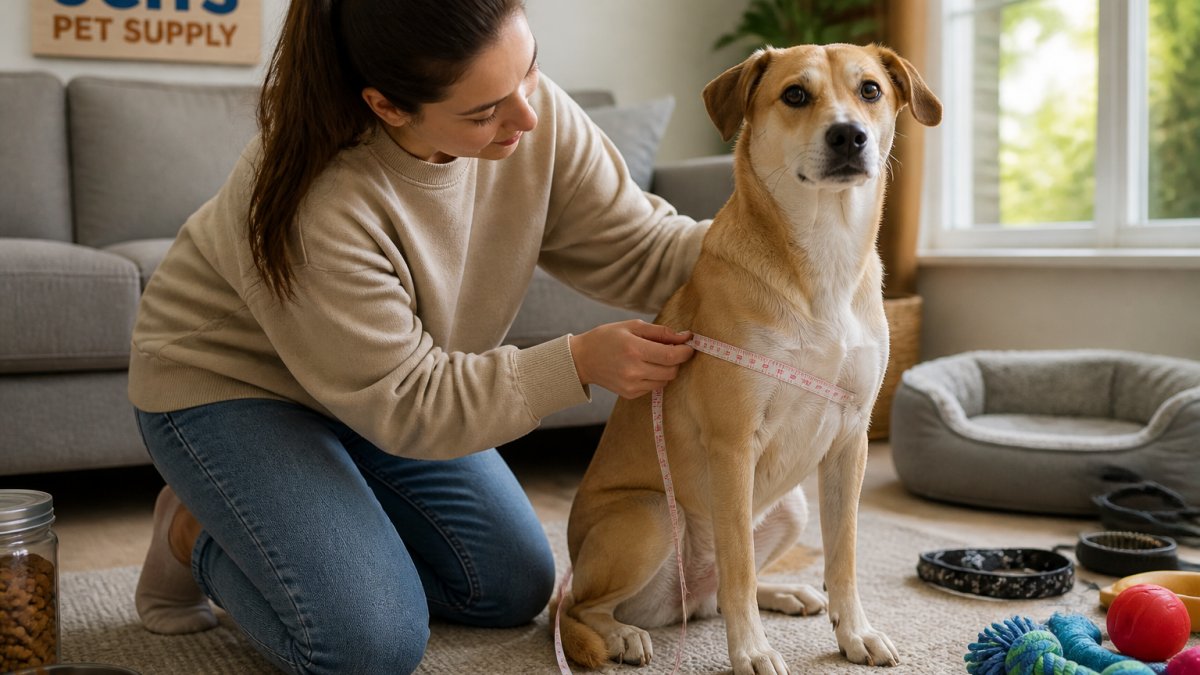
- Stand your dog square. All four paws on the floor, head forward, weight even. A sitting or lying dog gives a short reading.
- Find the widest part of the chest. Slide your hand back from the front legs until you feel the ribcage at its fullest point, usually just behind the shoulder blades.
- Wrap the tape around the torso. Pass it behind the front legs and around the back. Keep the tape level, not angled up or down.
- Snug it, then read. Pull until the tape touches the coat without pressing in. Slide two fingers under it. If they fit easily, the tape is too loose. Write the number down.
Repeat the measurement twice. If the readings differ by more than about half an inch, measure a third time and use the middle number.
Which Measurements Each Harness Style Actually Needs
Chest girth is the one number every harness style shares, but the rest depends on how the harness goes on.
| Harness style | Chest girth | Lower neck | Head circumference | Body length |
|---|---|---|---|---|
| Step-in | Required | Sometimes (neck opening) | Not needed | Not needed |
| Over-the-head | Required | Required | Required | Not needed |
| Vest / back-cover | Required | Required | Not needed | Required |
| Front-clip no-pull | Required | Required | Sometimes | Not needed |
- Step-in harnesses open flat and clip around the chest and neck. Chest girth and, if the chart lists one, a lower-neck measurement are enough.
- Over-the-head harnesses pass over the ears, so the head opening must clear the widest part of the skull. Measure head circumference and the jaw-to-crown distance in addition to chest girth.
- Vest and back-cover styles run along the spine, so body length, from the base of the neck to the base of the tail, decides whether the panel covers the back without riding up.
Measuring the Neck and Head for Over-the-Head Styles
- Lower neck: measure the base of the neck, where a collar sits, not up by the ears.
- Head: for harnesses that slip over the ears, measure the widest part of the head, usually across the cheeks just behind the eyes, and the distance from under the jaw to the top of the skull.
A head opening that is too small will not go on. One that is too large lets a determined dog back out.
Measuring Fluffy Coats, Puppies, and Unusual Body Shapes
- Fluffy and double-coated dogs: the tape compresses coat that a harness strap will also compress. Measure snug against the coat, then add about half an inch. A pre-measurement grooming session reduces the error.
- Puppies: measure the current chest, not the adult chest. Expect to remeasure roughly every four weeks during rapid growth, and favor a harness with generous strap adjustment.
- Deep-chested, narrow breeds (sighthounds and similar shapes) often measure large on girth but need a style with a longer chest panel so the strap does not slide forward.
Reading a Dog Harness Size Chart Without Getting Burned
Every brand builds its own chart, so a "medium" from one maker is not a medium from another. A fully adjustable, reflective harness in a specific size lets you see how a real size chart maps to an actual product. Read the chart before you fall in love with a pattern.
Rules that save returns:
Luxury Red Lips Breathable Mesh Harness Chest Back + Traction →
- Match your chest girth to the chart's chest range, not to the weight column
- Check the neck range too, if the harness lists one
- Size up if your number lands at the very top of a range
How Should a Dog Harness Fit Once It Arrives
A well-fitted harness gives you two fingers of room under every strap, sits behind the shoulder blades, and clears the throat completely. Measurements get you to the right size; this check confirms it on your dog.
Do this fit check before the first walk:
- Two fingers slide under the chest strap without force
- Neck opening clears the throat and does not press on it
- Straps sit level, not twisted
Fit Checks by Harness Style
- Step-in: clip the chest and neck straps, then watch the leg openings. If the harness bunches behind the elbows on a sit, the chest strap is too long.
- Over-the-head: the head opening should slide on without folding the ears. If you have to stretch it, the size is too small regardless of girth.
- Vest / back-cover: the back panel should end before the tail and not lift off the spine when the dog lowers its head to sniff.
Warning Signs to Watch For
- Slipping: the harness can be pulled forward over the shoulders, or the dog backs out of it when startled. This usually means the chest strap is too loose or the neck opening is too large.
- Rubbing: red marks, hair thinning, or a dog who scratches at the chest after ten minutes. Check for a twisted strap or a hard edge sitting on a bony point.
- Restricted movement: a shortened stride, reluctance to climb stairs, or a refusal to jump. The shoulder straps may be sitting too far forward over the shoulder joint.
Rechecking Fit Over Time
Fit is not permanent. A harness that was perfect in October can be loose by spring after winter weight loss, or tight after a summer of conditioning. Recheck the two-finger rule and the full checklist every few months and after any significant weight change.
What to Do If a Dog Is Between Harness Sizes
Between sizes is normal, especially for puppies and deep-chested breeds. The fix depends on the harness.
- Adjustable harnesses: pick the smaller size if the upper end of its range covers your dog; adjustable straps usually stretch the fit by a few inches.
- Fixed-size or padded harnesses: size up, a slightly loose harness can be adjusted, a tight one cannot.
- Puppies: measure now, expect to remeasure in a month, and buy for the current chest.
For dogs in the middle, an adjustable style with room at the top of its range is a sensible buy. You can compare a medium adjustable harness or a large-dog adjustable harness against your numbers before ordering.
Shop Harnesses Sized for Your Dog's Measurements
You have the numbers. Now match them to a harness that adjusts well and sits comfortably. A breathable reflective chest-and-shoulder harness gives your dog a comfortable everyday option to purchase after sizing. A multi-function tactical chest harness is a natural next step once you have your dog's measurements.
A few options worth a look:
- Luxury Red Lips Breathable Mesh Harness Chest Back + Traction for a breathable mesh fit
- Touchdog Reflective-Max 2-in-1 Performance Dog Harness and Leash for a reflective, multi-terrain harness and leash set
Check the size chart against your chest girth, not the weight column.

Frequently Asked Questions
Can I use my dog's weight to choose a harness size?
Weight alone is a weak guide. Two dogs at 40 pounds can have very different chest girths depending on build, coat, and breed. Use weight only as a rough starting point, then measure the chest girth around the widest part of the torso, just behind the front legs, and compare that number to the harness size chart. A dog with a deep chest and narrow waist may need a size up from what the weight range suggests.
How tight should a dog harness fit?
A harness should feel snug but not tight. You want room to slide two fingers under each strap without forcing them. The tape should sit level and contact the coat without compressing it. After fitting, watch your dog walk, sit, and turn. Straps that slide sideways, rub the armpits, or restrict the front legs mean the fit needs adjusting or the size is wrong. Check the fit again after the first few walks.
What should I do if my dog is between harness sizes?
Measure twice to confirm the number, then compare where your dog falls within each size range. If the measurement sits near the top of the smaller size, size up so the adjustable straps have room to work. If it sits near the bottom of the larger size, the smaller harness may fit better with straps let out. A harness with a wide adjustment range gives you more flexibility than one with a narrow band.
How do I measure a fluffy dog or a puppy for a harness?
For thick-coated dogs, press the tape gently against the coat rather than floating it over the fur, and measure twice to check consistency. Puppies need remeasuring every few weeks because their chest grows quickly. Buy a harness with generous adjustable straps so it can grow with your puppy, and check the fit monthly. Senior dogs with unusual body shapes benefit from the same careful approach: measure the actual torso, not the breed standard.
Getting the fit right takes ten minutes and saves weeks of returns and a dog who hates walks. Measure the chest girth, check the neck, and read the chart before you buy. At Jen's Pet Supply, we stock adjustable harnesses in small through large sizes, with breathable mesh, reflective stitching, and padded straps built for daily walks. Get started with Jen's Pet Supply and find a harness that fits your dog's actual measurements.
