

Last Updated: November 7, 2026
Quick Summary
Natural dental care for dogs centers on a consistent daily routine: brushing with dog-safe toothpaste, using dental chews or textured toys where brushing isn't tolerated, and scheduling regular veterinary checkups. Home care slows plaque buildup but cannot remove hardened tartar below the gumline, so professional cleanings remain necessary.
- Brush with dog-safe toothpaste, never human toothpaste, which can contain xylitol.
- Start brushing gradually, touching the muzzle and lips for a few seconds first.
- Look for the VOHC seal when comparing dental products.
- Use the thumbnail test: if a chew can't be dented with a fingernail, it may fracture teeth.
- Bleeding gums, loose teeth, or changed chewing habits warrant a veterinary exam.
Table of Contents
- Why Dog Dental Health Matters More Than Most Owners Realize
- How Plaque and Tartar Build Up on Dog Teeth
- Signs Your Dog Has Dental Disease or Oral Pain
- How to Clean Dog Teeth Naturally at Home
- How to Clean Dog Teeth Without Brushing
- Natural Remedies: What the Evidence Actually Supports
- Dog Dental Care Products and How to Choose Them
- Safe Chew Selection and When Home Care Is Not Enough
- Vet-Recommended Dog Teeth Cleaning and Your Next Step
- Frequently Asked Questions
Dental disease is one of the most common health problems in dogs, and most owners never see it coming. By the time bad breath or a visible tartar line appears, the damage below the gumline may already be well underway. The good news is that a simple daily routine, built around natural dental care methods that fit your dog's temperament, can do a lot to keep those teeth healthy between professional cleanings. This guide from Jen's Pet Supply walks through what actually works, what the evidence supports, and when a home routine is no longer enough.
Why Dog Dental Health Matters More Than Most Owners Realize
Dental health affects far more than your dog's breath. Bacteria that build up along the gumline can inflame the gums, and that inflammation can spread into the tissues that hold teeth in place. A dog with painful teeth may eat more slowly, drop food, or simply stop chewing on the side where it hurts.
Natural home care is a maintenance tool, not a replacement for veterinary assessment, and dental checkups with a veterinarian should happen regularly.
How Plaque and Tartar Build Up on Dog Teeth
Plaque is a soft film of bacteria that forms on teeth within hours of eating. If it is not removed, minerals in saliva harden it into tartar, which brushing cannot easily remove, so good natural dental care starts early. Tartar sits along the gumline, where it irritates the gums and encourages more bacteria to gather.
This is why the early stage matters most. Soft plaque is easy to disrupt with daily brushing or a suitable chew, while hardened tartar usually needs a professional cleaning.
Signs Your Dog Has Dental Disease or Oral Pain
Watch for bad breath that persists, yellow or brown buildup along the gumline, red or bleeding gums, drooling, pawing at the mouth, reluctance to chew hard food, or loose or missing teeth. Any of these warrants a veterinary exam.
Dogs rarely cry out about dental pain. Changes in eating habits are often the first clue, so pay attention if your dog starts favoring one side of the mouth or leaves food in the bowl.
How to Clean Dog Teeth Naturally at Home
A natural home routine works best when it is consistent. Choose a time that fits into your day, such as after an evening walk, and keep each session short and calm.
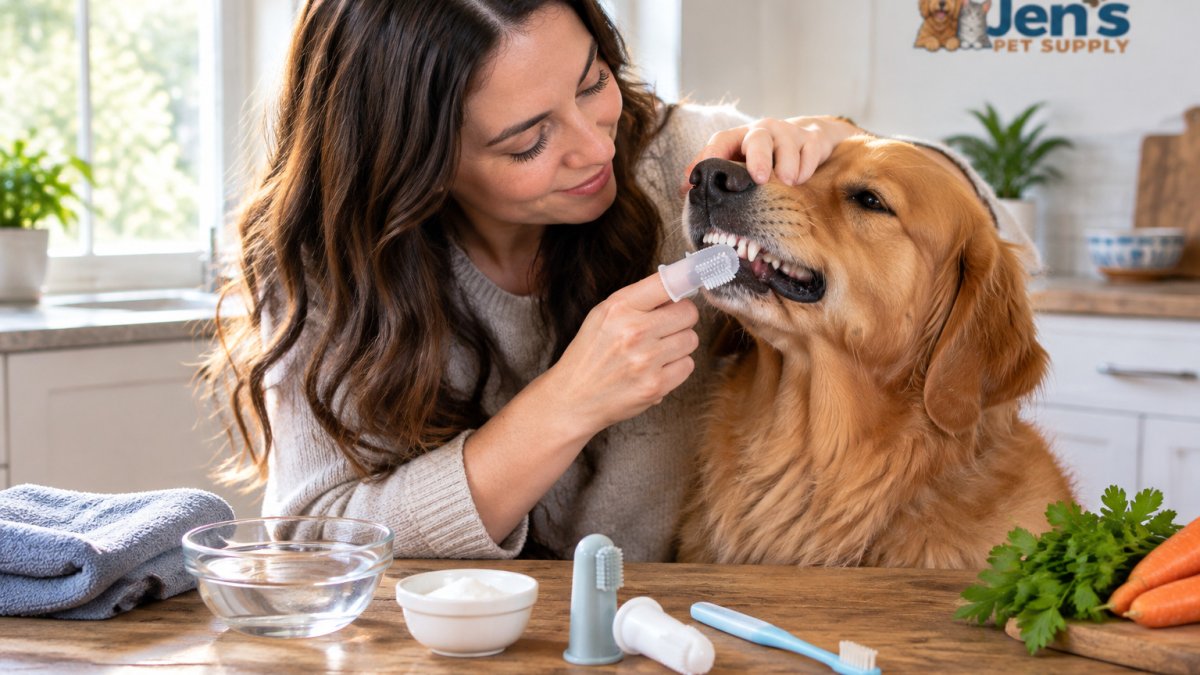
- Choose a dog-safe toothpaste (never use human toothpaste, which can contain xylitol).
- Pick a finger brush or soft dog toothbrush.
- Gently lift the lip and brush the outer surfaces of the teeth in small circles.
- Finish with a reward so your dog associates the routine with something positive.
!An owner gently lifting a golden retriever's lip with a finger brush in a bright, sunlit kitchen, the dog calm and relaxed
A Gradual Brushing Plan for Dogs Who Resist
Many dogs object to having their mouths handled. Start by touching the muzzle and lips for a few seconds, then add a finger with a small amount of toothpaste on it. Only progress to brushing once your dog accepts the finger without pulling away. Two to three weeks of short, rewarded sessions is a realistic timeline for many dogs, though some take longer.
Choosing Dog-Safe Toothpaste and Brushes
Look for toothpaste made specifically for dogs, which is formulated to be swallowed safely. Finger brushes suit small or nervous dogs, while longer-handled brushes give better reach for larger mouths. Products carrying the Veterinary Oral Health Council (VOHC) seal are a useful filter when comparing options (Accepted Products).
For a ready-made option, the Pet Toothpaste Dog Toothbrush Cat Toothbrush Finger Toothbrush For Dogs And Cats Pet Dental Care Set bundles toothpaste and brushing tools in one kit, which makes starting a routine simpler.
How to Clean Dog Teeth Without Brushing
Some dogs will never tolerate a toothbrush, and that is workable. Dental chews can help reduce soft plaque as dogs chew, though they do not clean below the gumline. Several providers offer dental-focused chews, and the Large Dental Support Chew Sticks with Probiotics for Dogs are one example of a chew sized for larger dogs.

Dental powders that are mixed into food are another option. The Natural Pet Dental Powder is mixed into food for dogs and cats over four months old. Check the product listing for age guidance and always follow the label.

Natural Remedies: What the Evidence Actually Supports
"Natural" is a marketing word, not a safety certification. A product can be plant-based, chemical-free, and still be useless or actively harmful to a dog. The useful question is not whether a remedy is natural but whether there is a plausible mechanism, any controlled evidence, and a known safety profile. Most over-the-counter dental remedies fail at least one of those three tests.
Here is how the remedies owners ask about most often actually stack up.
Tooth brushing with dog-safe toothpaste is the one home method with broad veterinary consensus behind it. Mechanical disruption of soft plaque is the mechanism, and it is well understood.
VOHC-accepted products are the closest thing to a shortcut through the marketing noise. A VOHC seal is a meaningful filter, and many natural-remedy claims do not carry one.
Dental chews and textured toys work through abrasion and increased chewing time, which can reduce soft plaque on the outer tooth surfaces. They do not reach below the gumline, and their value depends heavily on matching the chew to the dog's bite force, covered in the chew selection section below.
Raw bones are the most contested recommendation in natural-care circles. The documented risks include tooth fracture, choking, gastrointestinal obstruction, and bacterial contamination. Whether the mechanical cleaning benefit outweighs those risks is a decision to make with your veterinarian.
Coconut oil, herbal additives, and food-based powders have limited or no controlled evidence for reducing plaque or tartar in dogs. Some contain ingredients that are safe in small amounts but not in the quantities a dog would need to show any effect. Others, including certain essential oils, are toxic to dogs at low doses. Read the ingredient panel, not the front of the package.
Water additives vary widely. Some contain chlorhexidine or zinc compounds with published evidence; many contain only flavoring. Check for a VOHC seal or a named active ingredient with a stated concentration.
Watch out: any product marketed as a substitute for professional cleaning or as a cure for existing dental disease should be treated as a red flag, regardless of how natural its ingredients are.
A practical filter for any new remedy: does it carry a VOHC seal or a named active ingredient with published evidence, does the label list a safe dose for your dog's weight, and has your veterinarian confirmed it will not interact with any medication your dog takes?
Dog Dental Care Products and How to Choose Them
Choose products based on your dog's size, age, and chewing style rather than marketing alone. A product that suits a small senior dog may be wrong for a strong adult chewer.
The Dental with Mint Topper is a seaweed-based daily topper for dogs and cats. Its label advises consulting your vet if your pet has thyroid conditions, so check with your vet before starting it. For dogs that enjoy playing with their mouths, the Dental Cleaning Tug Toy with a textured weave can add a cleaning element to supervised play.

The table below compares the dental product types covered in this guide, so you can match each one to your dog's needs.
| Product type | Best for | Key difference |
|---|---|---|
| Dog-safe toothpaste and brush | Dogs that accept handling | Mechanical plaque removal |
| Dental chews | Dogs that refuse brushing | Reduces soft plaque while chewing |
| Dental powder in food | Dogs that refuse brushing | Mixed into food; check age guidance |
| Daily seaweed-based topper | Daily routine with food | Check with vet if thyroid conditions |
| Textured tug toy | Dogs that enjoy play | Cleaning during supervised play |
Safe Chew Selection and When Home Care Is Not Enough
Chews are the most common source of preventable dental injury in dogs, and the injuries are predictable once you know what to look for. Tooth fracture, choking, and gastrointestinal blockage all trace back to the same three variables: hardness, size relative to the dog, and chewing style.
Hardness. A useful rule of thumb from veterinary dentists is the thumbnail test: if you cannot make an indentation in the chew with your fingernail, it is hard enough to fracture a tooth. That rules out most bones, antlers, hooves, and nylon chews sold as "dental" products. The dogs most at risk are those with existing cracked teeth, worn enamel, or a history of slab fractures, often older dogs and strong chewers.
Size relative to the dog. A chew should be large enough that the dog cannot fit it entirely in the mouth and cannot swallow it whole once it softens. For strong chewers, that often means sizing up rather than down. Remove any chew once it becomes small enough to swallow.
Chewing style. Some dogs gnaw methodically; others gulp, tear, and swallow. Gulpers and tearers do better with softer, digestible chews and textured toys than with hard compressed chews. Anxious chewers may need a chew that redirects the behavior rather than one that rewards aggressive biting.
Life stage. Puppies under about six months have softer enamel and should not be given hard chews. Senior dogs often have worn or missing teeth and may do better with soft textured toys or dental wipes than with any chew at all. Small breeds and brachycephalic dogs have different choking geometry and should be supervised closely with any chew.
Digestibility. Chews that are not fully digestible, rawhide, some nylon products, and certain compressed starch chews, carry a blockage risk if swallowed in large pieces. Digestible chews reduce that risk but are not risk-free.
For dogs that need a mechanical cleaning option without a hard chew, textured tug toys and dental wipes are an alternative to discuss with your veterinarian. The Dental Cleaning Tug Toy with a textured weave is designed for supervised tugging and chewing, which lets you control the session and stop if the dog starts to swallow pieces. The Large Dental Support Chew Sticks with Probiotics for Dogs are sized for larger dogs.
When Home Care Is Not Enough
Home care cannot remove tartar that has hardened below the gumline, and it cannot reverse established periodontal disease. The signs that a dog needs a veterinary exam rather than another product include:
- Bleeding gums, especially after gentle brushing
- Loose or missing teeth
- A sudden change in eating, chewing on one side, or dropping food
- Bad breath that persists despite a consistent routine
- Swelling around the muzzle or under the eye
- Pawing at the mouth or reluctance to have the mouth touched
A common pattern is that owners add more products when the real problem is a tooth that needs extraction or a pocket that needs scaling. Adding chews or powders to an infected mouth does not fix the infection and can make it more painful. If any of the signs above are present, schedule a veterinary exam before adding anything new to the routine.
Vet-Recommended Dog Teeth Cleaning and Your Next Step
A professional cleaning, performed under anesthesia, lets a veterinarian scale tartar above and below the gumline, polish the teeth, and examine each one. Ask your vet how often your dog needs a cleaning and what home routine they recommend alongside it. Combining professional care with a daily home routine gives your dog the best chance of healthy teeth for years to come.
Start with one small step this week: pick a product, schedule a vet check if one is overdue, and begin the gradual brushing plan. Browse the dental care range at Jen's Pet Supply to find tools that fit your dog's needs.
Frequently Asked Questions
What dissolves plaque on dogs' teeth naturally?
Daily brushing is the most effective way to disrupt plaque before it hardens, . Some owners use enzymatic dental powders or specially designed chews to support that routine. These products can help reduce soft buildup, but they do not dissolve tartar that has already hardened. Once tartar forms, only a veterinary cleaning removes it, so check your dog's teeth regularly and see your vet if you notice discoloration or a rough, crusty layer near the gumline.
What is the best natural way to clean a dog's teeth?
The most reliable natural method is brushing with a dog-safe toothpaste and a soft brush or finger brush for a few minutes most days. Start slowly, letting your dog taste the toothpaste first, and work up to brushing the outer surfaces of the teeth. Dental chews and dental powders can supplement this routine, but they work best alongside brushing rather than instead of it. Never use human toothpaste, which can contain xylitol and other ingredients that are toxic to dogs.
Are dental chews effective for dogs?
Some dental chews can reduce plaque when they are the correct size, texture, and chewing style for your dog. Some dental chews carry a Veterinary Oral Health Council (VOHC) seal, which can be a useful filter when choosing a chew. Hard chews that are too firm can crack or chip teeth, and very small pieces can pose a choking risk. Supervise your dog while chewing and check with your veterinarian about the best option for your dog's age and size.
When should a dog see a veterinarian for dental care?
Schedule a veterinary dental exam if you notice bad breath that persists despite home care, red or bleeding gums, loose or broken teeth, drooling, pawing at the mouth, or difficulty eating. Regular veterinary checkups of your dog's teeth and gums are recommended. Home care cannot treat existing periodontal disease or remove hardened tartar below the gumline, so a professional cleaning under anesthesia is often necessary.
